
Accessibility Checklist for Testers
Accessibility testing can feel overwhelming when you are not always sure what to look for or how to prioritise what matters.
This checklist is a practical guide for testers, QA practitioners and accessibility advocates who want a clear and consistent way to identify common accessibility issues.
For each area, it includes how to test, the potential user impact, and relevant WCAG criteria. The goal is not just to help you find issues, but to help you understand why they matter and how they affect real users. It doesn’t include screen reader testing, instead focusing on other important foundational checks that help build consistency and confidence in everyday testing work.
Use this checklist as a reference during testing, or as a learning tool to build shared understanding of accessibility issues within your team.
When you’re ready, take your practice further by embedding accessibility into your workflow.
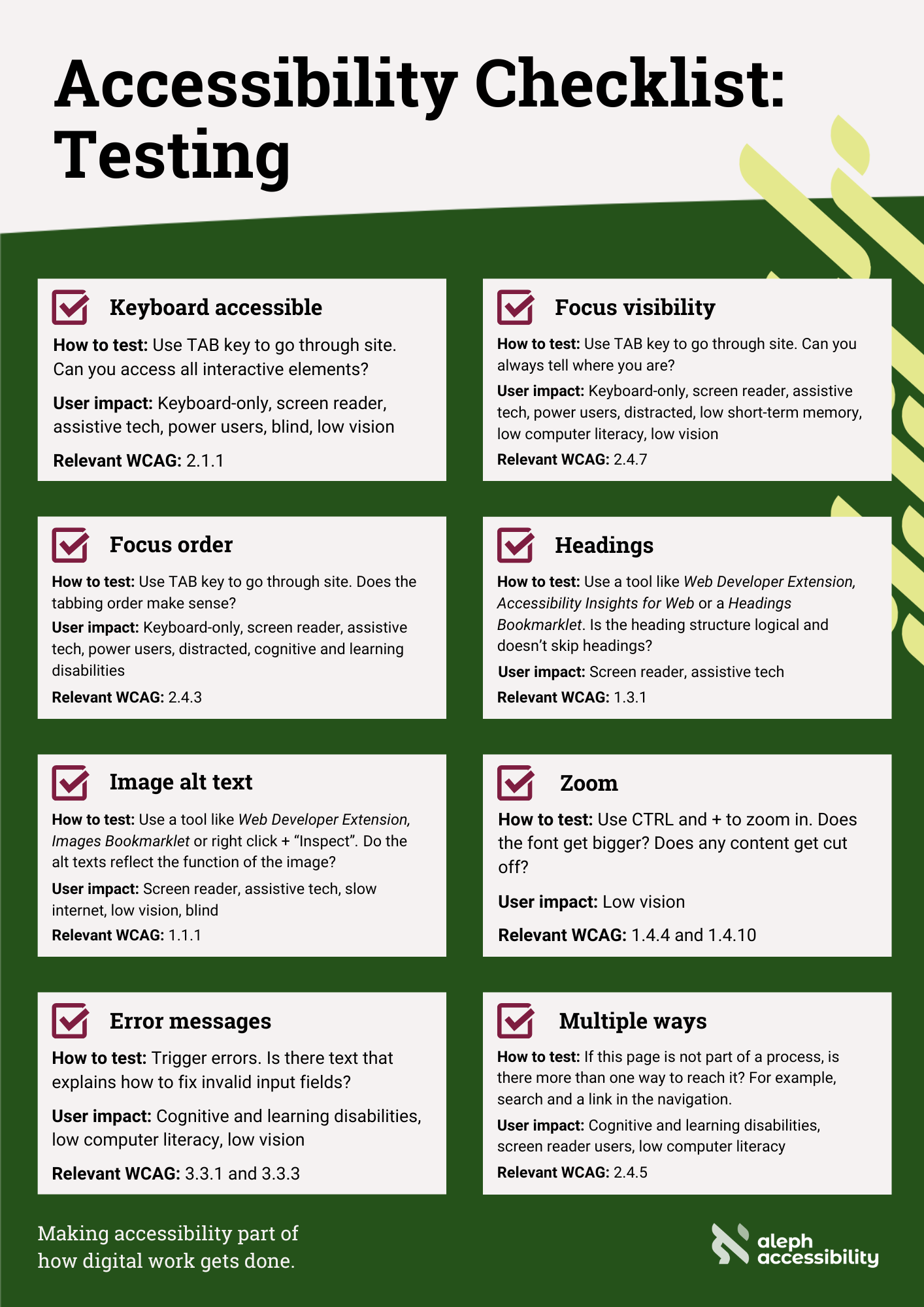
- Keyboard accessible
- How to test: Use TAB key to go through site. Can you access all interactive elements?
- User impact: Keyboard-only, screen reader, assistive tech, power users, blind, low vision
- Relevant WCAG: 2.1.1
- Focus visibility
- How to test: Use TAB key to go through site. Can you always tell where you are?
- User impact: Keyboard-only, screen reader, assistive tech, power users, distracted, low short-term memory, low computer literacy, low vision
- Relevant WCAG: 2.4.7
- Focus order
- How to test: Use TAB key to go through site. Does the tabbing order make sense?
- User impact: Keyboard-only, screen reader, assistive tech, power users, distracted, cognitive and learning disabilities
- Relevant WCAG: 2.4.3
- Headings
- How to test: Use a tool like Web Developer Extension, Accessibility Insights for Web or a Headings Bookmarklet. Is the heading structure logical and doesn’t skip headings?
- User impact: Screen reader, assistive tech
- Relevant WCAG: 1.3.1
- Image alt text
- How to test: Use a tool like Web Developer Extension, Images Bookmarklet or right click + “Inspect”. Do the alt texts reflect the function of the image?
- User impact: Screen reader, assistive tech, slow internet, low vision, blind
- Relevant WCAG: 1.1.1
- Zoom
- How to test: Use CTRL and + to zoom in. Does the font get bigger? Does any content get cut off?
- User impact: Low vision
- Relevant WCAG: 1.4.4 and 1.4.10
- Error messages
- How to test: Trigger errors. Is there text that explains how to fix invalid input fields?
- User impact: Cognitive and learning disabilities, low computer literacy, low vision
- Relevant WCAG: 3.3.1 and 3.3.3
- Multiple ways
- How to test: If this page is not part of a process, is there more than one way to reach it? For example, search and a link in the navigation.
- User impact: Cognitive and learning disabilities, screen reader users, low computer literacy
- Relevant WCAG: 2.4.5
Aleph Accessibility helps organisations make clearer, more confident accessibility decisions across design, delivery and procurement.
If you want to make accessibility part of the way you work, you can learn more about our audits, consulting and training, or get in touch for a short, no-obligation conversation.